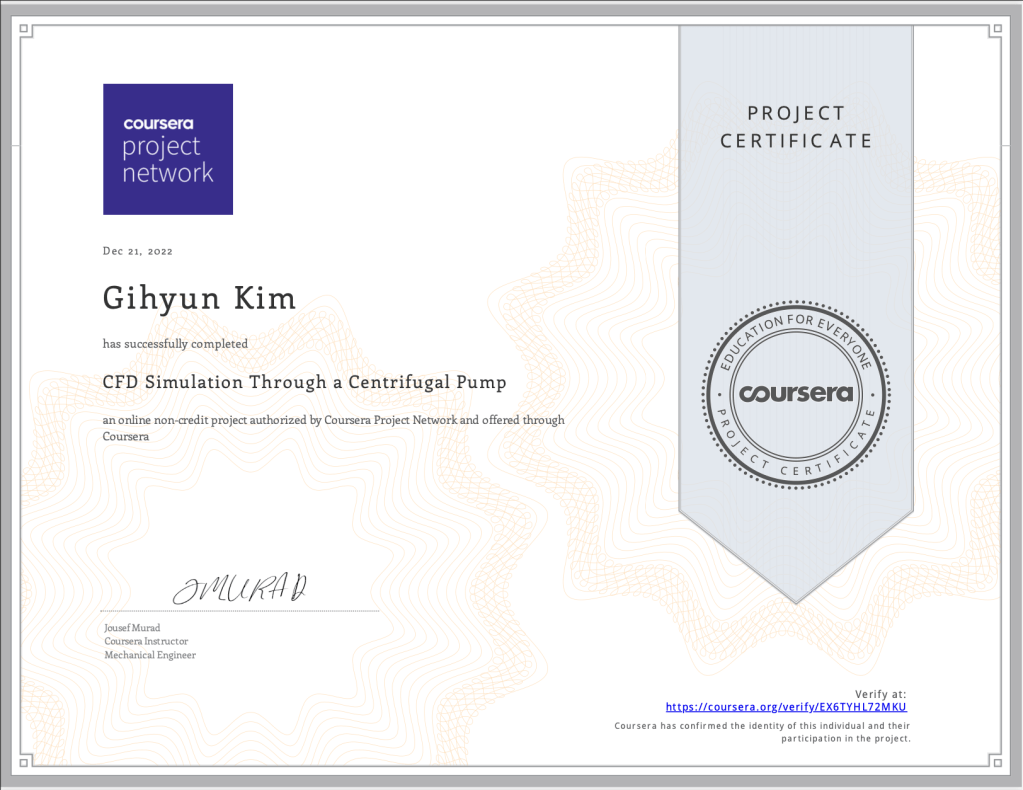
Topic: CFD Simulation Through a Centrifugal Pump
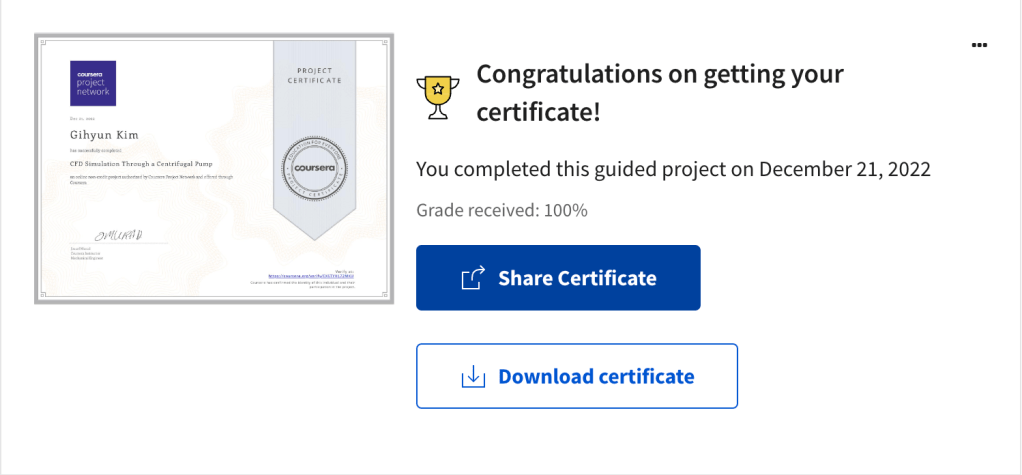
Date completed: December 21st, 2022
Summary:
This course focused on the processes behind using CFD (Computational Fluid Dynamics) through a centrifugal pump.
To begin with, a CFD is a computer system that allows engineers and scientists to predict the behavior of fluids. This program mainly focuses on the laws of conservation (the law of conservation of mass, energy, and momentum). All of which state that mass, energy, and momentum during different changes in motion. For example, when an object is initially at rest 5 meters above the ground and is then released, the potential energy it has would be converted to kinetic energy by the time the object reaches the ground (h = 0) – all of this is true only if the object is in a vacuum where none of the initial potential energy the object had is converted to friction (air resistance), sound (when the object hits the ground), or heat (albeit small amounts, heat can form due to the impact and the friction). The simulation system uses these and other concepts regarding physics and computer programming to recreate a visual simulation of how fluids or air particles will behave in certain situations.
Furthermore, a centrifugal pump uses rotational kinetic energy to pump different fluids. A combination of CFD and centrifugal pumps results in a visual representation of how well/effectively the pump will work without making a physical model.
By taking this course, I learned the different components and techniques that are required for making a successful simulation. To illustrate, I learned about the “no slip” boundary condition – which is a condition that assumes that at a solid boundary, the fluid will have zero velocity relative to the boundary – the role of a mesh, and what an MRF (Multi Reference Frame) is. In the end, I was able to score a 100% on the final quiz and learned numerous interesting things regarding CFD simulations. This knowledge may prove useful in the future when I have to test different models and determine which is most effective.
Link for verification: https://coursera.org/verify/EX6TYHL72MKU
 Gihyun Kim
Leave a comment